
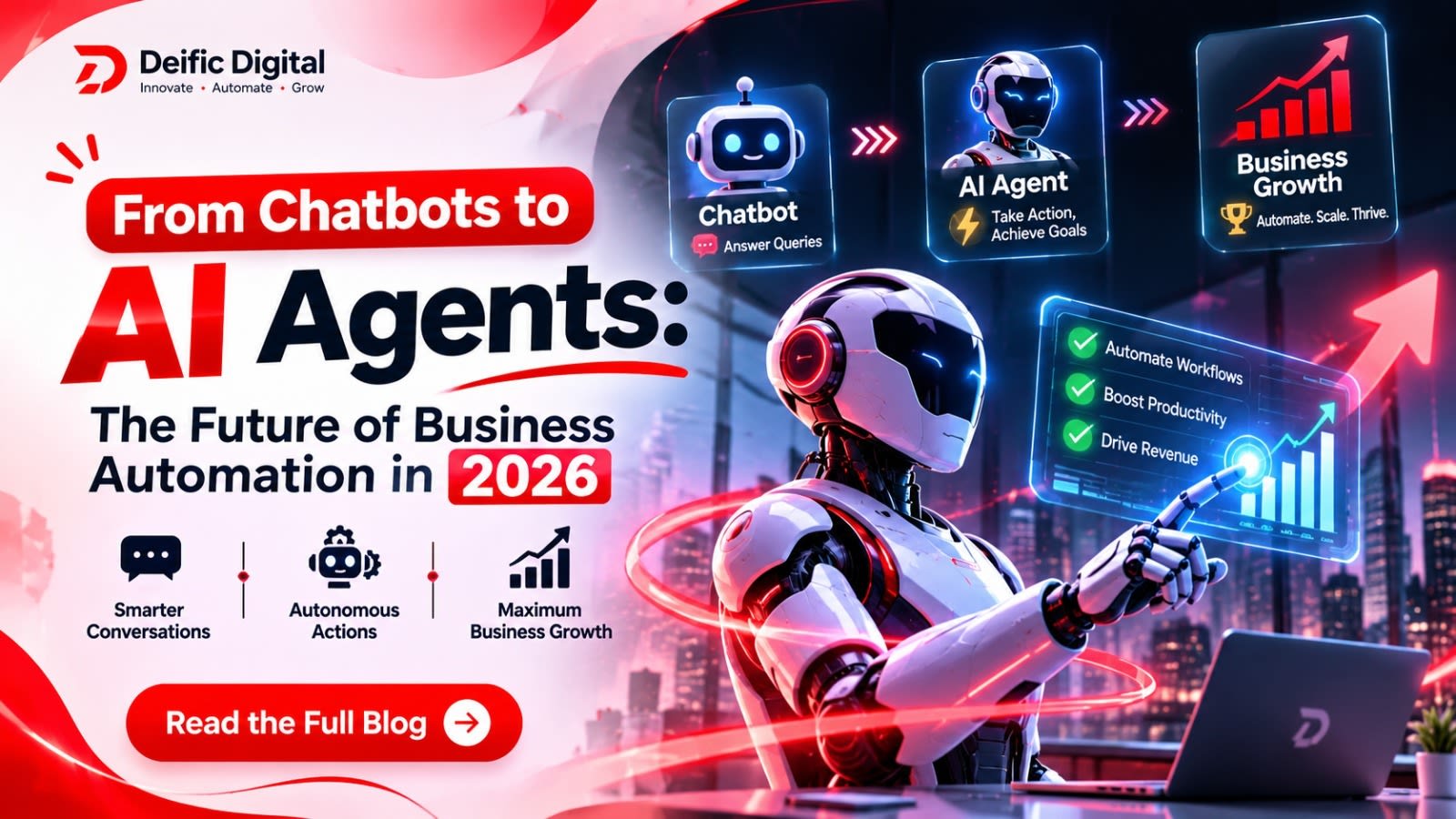
From Chatbots to AI Agents: The Future of Business Automation in 2026
By Deific Digital · Nov 16, 2026 · 10 min read
Quick answer
**What is the difference between chatbots and AI agents?**
AI chatbots primarily answer questions and handle conversations, while AI agents can understand goals, use connected tools, make decisions, and perform multi-step business tasks. In 2026, businesses are increasingly exploring AI agents to automate customer support, sales, WhatsApp communication, and everyday workflows.
Artificial Intelligence is changing the way businesses operate. What once seemed like something out of a science-fiction movie is now helping companies manage customers, automate everyday tasks, and make their operations more efficient.
Think about the last time you visited a business website and had a question. Instead of waiting for someone to reply, you probably interacted with a chatbot.
That was a big step forward.
But AI has moved beyond answering questions. Today, businesses can use AI agents that understand instructions, connect with different applications, and actually complete tasks.
Imagine an AI system that doesn't just tell a customer how to book a meeting but checks your calendar, finds an available slot, schedules the meeting, and sends a confirmation.
That's a completely different level of automation.
In 2026, the conversation is no longer just about chatbots. It's about building smarter business operations with AI agents.
Let's understand what this shift means and how businesses can benefit from it.
1. The Evolution of AI: From Simple Conversations to Real Actions
A few years ago, customer support was mostly manual. Businesses relied on phone calls, emails, and support teams to answer even the simplest questions.
Then chatbots entered the picture.
They helped businesses respond faster, remain available around the clock, and handle multiple customer conversations simultaneously.
But there was one limitation: most traditional chatbots could talk about a task without actually completing it.
For example, imagine a customer visiting your website and asking:
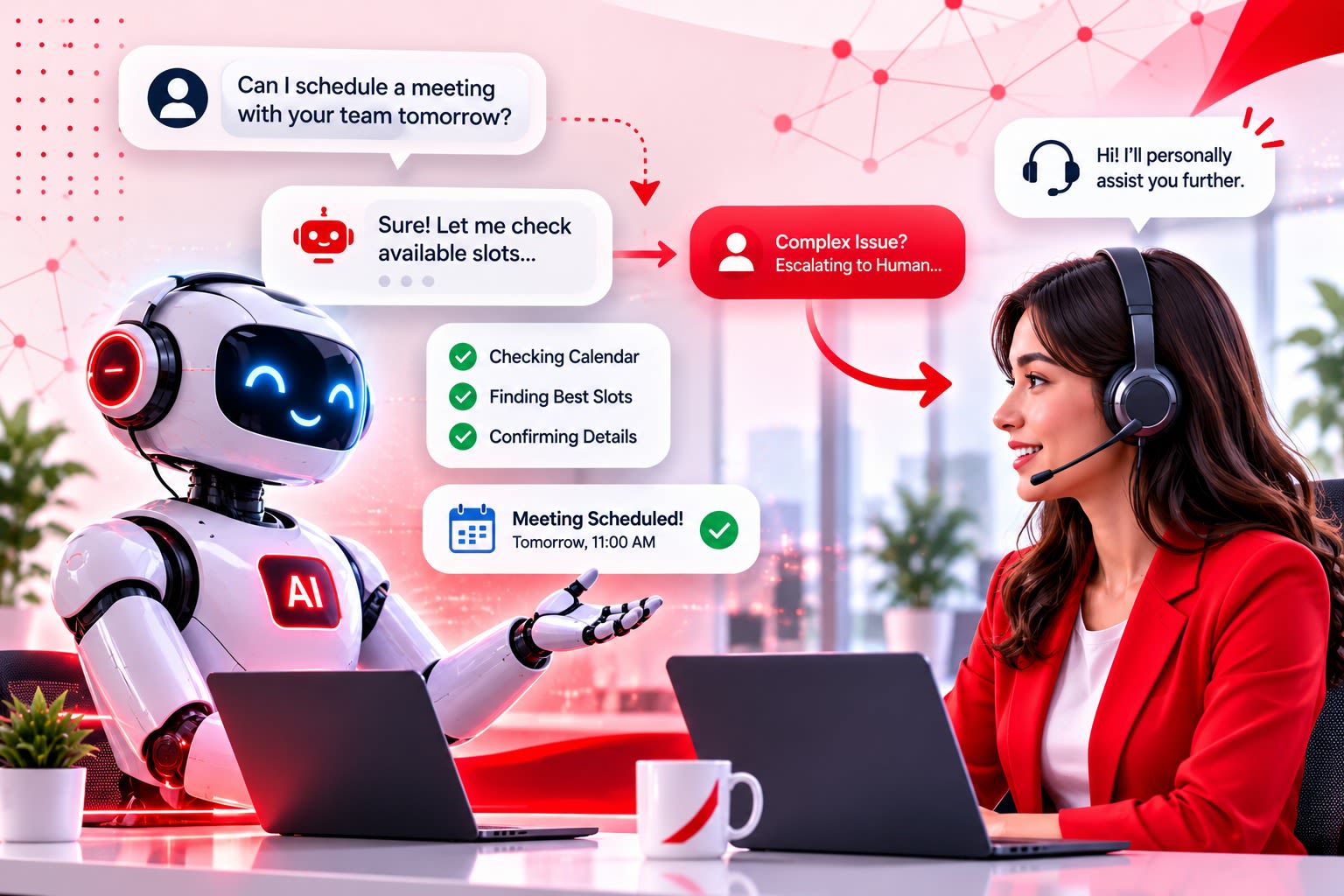
"Can I schedule a meeting with your team tomorrow?"
A basic chatbot might share your contact information or provide a booking link.
An AI agent, when connected to your calendar and booking system, could check available slots, collect customer details, schedule the meeting, and send a confirmation.
See the difference?
One provides information. The other can take action.
That's the real evolution of business automation: moving from systems that simply communicate to systems that help get work done.
2. What Exactly Are AI Agents?
Let's keep it simple.
An AI agent is an intelligent software system that understands a goal, determines what steps are needed, and uses connected tools to complete tasks.
Think of it as a digital team member that can take care of specific responsibilities.
For example:
- An AI sales agent can talk to potential customers, understand their requirements, collect lead information, and update your CRM.
- An AI customer support agent can answer questions, retrieve information, and pass complicated issues to a human representative.
- An AI scheduling agent can check availability, arrange meetings, and send confirmations.
What makes AI agents particularly useful is their ability to connect different business processes.
Instead of employees constantly switching between applications and manually updating records, suitable tasks can be handled through connected AI-powered workflows.
Of course, an agent's capabilities depend on its integrations, permissions, and security controls.
The goal isn't to replace every employee. It's to give your team a smarter way to work.
3. AI Chatbots vs AI Agents: What's the Real Difference?
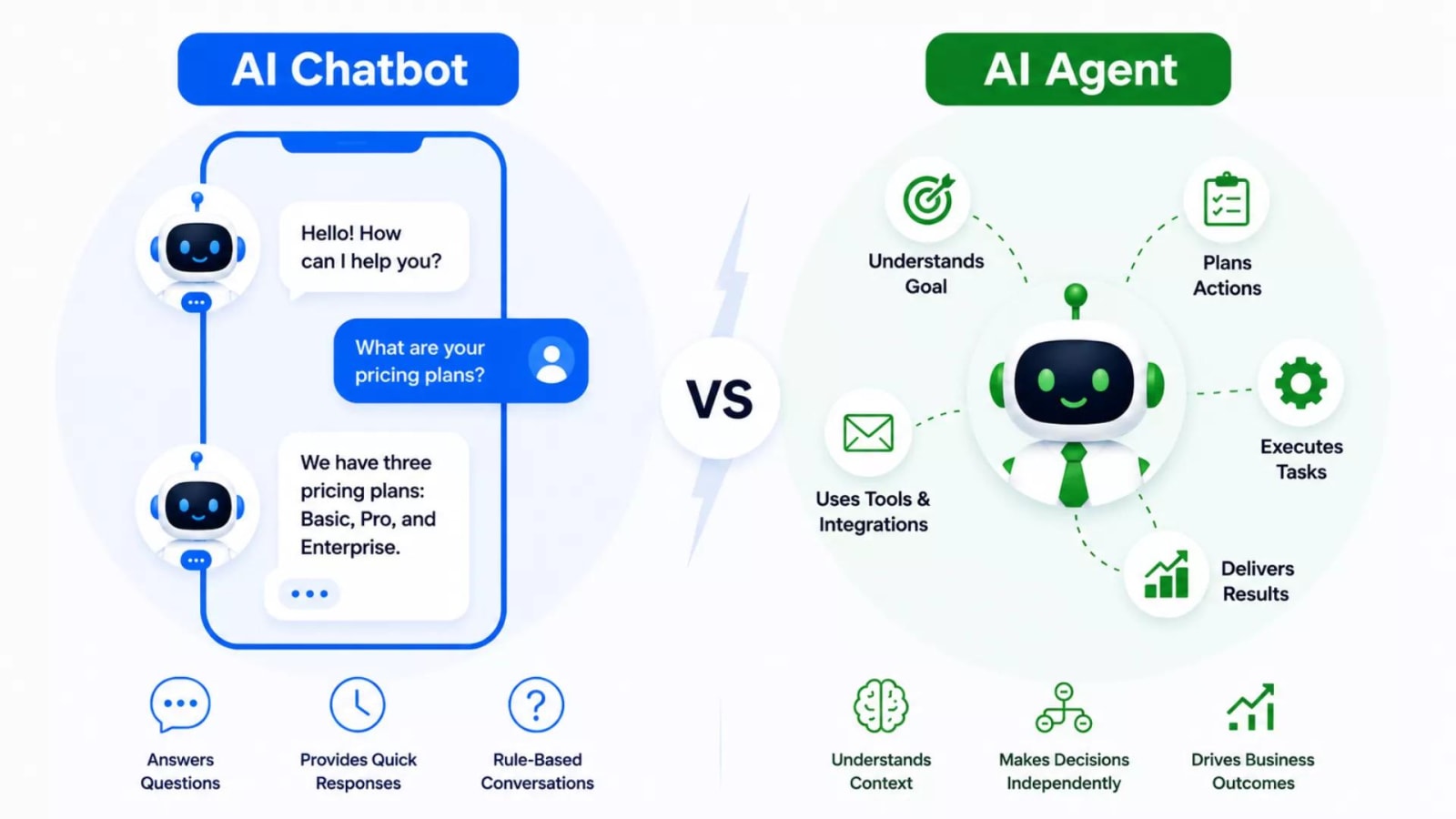
Both technologies can communicate with customers, which is why people often use these terms interchangeably.
However, they don't necessarily do the same job.
AI Chatbots
Chatbots are primarily designed to communicate with users.
They can:
- Answer frequently asked questions.
- Share product and service information.
- Help visitors navigate a website.
- Provide instant customer responses.
- Handle predefined or AI-powered conversations.
AI Agents
AI agents go a step further by working towards specific objectives.
They can:
- Understand and work towards assigned goals.
- Connect with business applications.
- Perform multi-step tasks.
- Retrieve and process relevant information.
- Automate workflows within their permissions.
Here's an easy way to understand it:
A chatbot can tell a customer how to book an appointment. An AI agent can potentially complete the booking through an integrated scheduling system.
And here's something important: businesses don't always have to choose one over the other.
A chatbot can act as the communication interface while an AI agent handles the actual work in the background.
Together, they can create a much more useful customer experience.
4. Where Can Businesses Actually Use AI Agents?
This is where things get interesting.
AI agents aren't limited to answering customer questions. They can support different departments and automate repetitive business processes.
Let's look at some practical examples.
AI-Powered Customer Support
Nobody likes waiting hours for an answer to a simple question.
Businesses can use AI agents to respond to common inquiries, retrieve information from knowledge bases, check service details, and organize support requests.
For example, a customer might ask about a service, request an update, or need help understanding a product.
An AI agent can handle suitable requests automatically and transfer more complicated issues to a human support representative.
This allows your support team to spend less time answering the same questions and more time helping customers who need personal attention.
Smarter Sales and Lead Generation
Every business wants better leads, but managing incoming inquiries manually can become exhausting.
Imagine someone visiting your website at midnight and asking about your services.
Normally, that visitor might leave without receiving an immediate response.
An AI sales agent can start the conversation, understand what the visitor needs, ask relevant questions, and collect their contact details.
With the right CRM integration, it can also save lead information and arrange a follow-up for your sales team.
The benefit is simple: fewer opportunities get missed just because nobody was available to respond.
WhatsApp AI Automation
For businesses in India, the UAE, and many other markets, WhatsApp has become an important part of everyday communication.
Now imagine combining WhatsApp with an intelligent AI agent.
Customers could:
- Ask questions about products and services.
- Receive relevant information instantly.
- Check order updates.
- Schedule appointments.
- Get assistance without waiting for a manual reply.
Businesses can also organize incoming leads and send relevant follow-up messages through properly configured WhatsApp Business integrations.
Instead of manually handling every conversation, your team gets a more organized way to communicate with customers.
Intelligent Business Workflows
Not every business problem involves customer conversations.
Think about how much time employees spend organizing information, updating records, preparing reports, and notifying different departments.
These tasks may look small individually, but together they consume a lot of working hours.
AI-powered workflows can connect these processes.
For example, when a new customer inquiry arrives, an automated workflow could:
- Identify and categorize the inquiry.
- Save the customer's information in the CRM.
- Notify the relevant team.
- Create a follow-up task.
- Prepare the information needed for the next interaction.
This is how businesses can reduce repetitive work without unnecessarily complicating their operations.
5. Industries That Can Benefit from AI Agents
One of the biggest advantages of AI automation is that it isn't restricted to technology companies.
Almost every industry has repetitive processes that could benefit from intelligent automation.
Here are some examples:
E-commerce: Product discovery, order tracking, customer inquiries, and personalized recommendations.
Real Estate: Property inquiries, lead qualification, appointment scheduling, and sharing property information.
Healthcare: Appointment coordination, administrative communication, and routine information requests, with appropriate privacy and security safeguards.
Education: Student inquiries, admission assistance, course information, and administrative support.
Travel and Hospitality: Booking assistance, itinerary information, reservation inquiries, and customer support.
Professional Services: Client onboarding, meeting scheduling, lead management, and document workflows.
The important thing is to identify where your business spends the most time on repetitive work.
You don't need to automate everything at once. Sometimes solving one everyday problem can make a noticeable difference.
6. Why 2026 Is an Important Year for AI Automation
Businesses are beginning to look at AI differently.
Earlier, many companies experimented with chatbots simply because AI was becoming popular.
Now, the focus is shifting towards practical results.
Businesses want to know:
- Can AI help us respond to customers faster?
- Can we manage more leads without increasing manual workload?
- Can repetitive tasks be automated?
- Can our existing applications work together more efficiently?
These are the questions driving interest in AI agents and intelligent automation.
Here are some potential benefits:
Save Valuable Time
Automating repetitive activities gives employees more time to focus on important responsibilities.
Improve Customer Experience
Customers can receive faster responses and more convenient support.
Organize Lead Management
Incoming inquiries can be captured, categorized, and directed to the appropriate team.
Support Business Growth
Well-designed automation can help businesses manage increasing workloads more efficiently.
Create Consistent Workflows
Automated processes can reduce avoidable manual errors and make routine operations more organized.
However, automation isn't about removing people from every process.
It's about helping people spend less time on repetitive work and more time on decisions, relationships, and activities that genuinely need human attention.
7. What Should Businesses Consider Before Implementing AI Agents?
AI agents can be extremely useful, but simply connecting an AI model to your business applications doesn't guarantee a successful automation system.
A little planning goes a long way.
Start With a Real Business Problem
Don't automate something just because AI can do it.
Look at your daily operations. Which tasks consume the most time? Where do customers experience delays? Which processes involve unnecessary manual work?
Start there.
Choose the Right AI Solution
Not every business needs an advanced AI agent.
Sometimes a simple chatbot is enough. Other workflows may require an agent capable of using multiple applications and completing several steps.
Choose technology based on what you actually need.
Connect the Right Tools
AI agents become more useful when they can securely interact with relevant applications.
Depending on your requirements, these might include CRM platforms, calendars, databases, booking systems, and communication tools.
Take Data Security Seriously
AI systems may interact with customer information and internal business data.
Use appropriate permissions, access controls, and data protection policies to keep that information secure.
Keep Humans in the Loop
Not every decision should be automated.
Sensitive transactions, complicated customer issues, and important business decisions should have suitable human approval or escalation processes.
A good automation system knows when to take action and when to involve a person.
8. What's Next? The Future of AI Agents
The development of AI agents is opening up some interesting possibilities for businesses.
We're moving towards systems where multiple specialized agents can work together to support different business activities.
Imagine an e-commerce company using:
- One agent to assist customers.
- Another to manage product information.
- Another to support order-related workflows.
- Another to organize internal reports.
Each agent handles a specific responsibility, while connected workflows help information move between systems.
Voice-enabled AI agents are also creating new opportunities for businesses that receive large numbers of phone inquiries.
As these technologies continue to develop, businesses will have more options for building intelligent systems around their everyday operations.
But the biggest opportunity isn't simply adding more AI tools.
It's making those tools work together to solve real business problems.
9. How Deific Digital Helps Businesses Move Towards AI-Powered Operations
At Deific Digital, we believe technology should make running a business easier, not more complicated.
Every business has different customers, challenges, and workflows. That's why an AI solution should be designed around actual business requirements rather than simply following the latest technology trend.
We focus on helping businesses explore practical AI-powered solutions, including:
Custom AI Chatbots: Conversational experiences designed around your business, services, and customer requirements.
AI Agents: Intelligent assistants that can work with connected applications and perform specific business tasks.
WhatsApp AI Automation: Smarter customer communication, inquiry management, and automated interactions.
AI Workflow Automation: Connecting business applications and reducing repetitive manual processes.
AI Integrations: Bringing AI capabilities into your existing digital ecosystem.
Whether you're a startup looking to manage customer inquiries or an established company exploring advanced business automation, the right starting point is understanding how your business works.
At Deific Digital, our goal is simple: help businesses innovate, automate, and grow with practical AI-powered solutions.
Final Thoughts
The journey from chatbots to AI agents represents more than just another technology upgrade.
It's a change in how businesses can use technology to get everyday work done.
We've moved from systems that simply answer questions towards systems that can understand goals, interact with connected tools, and complete useful tasks.
For businesses, this creates opportunities to improve customer experiences, organize operations, and make better use of their team's time.
Of course, AI agents aren't magic. They won't solve every business challenge overnight, and they still need proper planning, integrations, and human oversight.
But when implemented thoughtfully, they can become valuable digital assistants that support real business growth.
The future isn't just about having AI in your business. It's about making AI work for your business.
Ready to Explore AI Automation for Your Business?
Let's turn your ideas into intelligent digital solutions.
Deific Digital — Innovate. Automate. Grow.
Frequently Asked Questions
What is an AI agent in simple terms?
An AI agent is a software system that can understand a goal, decide which steps are needed, and perform tasks using connected tools and applications.
Are AI agents better than traditional chatbots?
They serve different purposes. Chatbots are useful for answering questions and handling conversations, while AI agents can also perform tasks and automate workflows. The right choice depends on your business requirements.
Can AI agents work with WhatsApp?
Yes. With suitable WhatsApp Business Platform integrations, AI agents can help manage customer conversations, answer inquiries, and automate selected workflows.
How much does it cost to implement an AI agent?
The cost depends on the complexity of the solution, AI model, integrations, infrastructure, and business requirements. A basic assistant generally requires less development than a fully integrated system handling multiple workflows.
Keep reading
Have a project in mind?
Talk to our team for a free consultation and a written proposal.
Get free consultation